
Physics A Level | Chapter 16: Circular motion 16.2 Angles in radians
When dealing with circles and circular motion, it is more convenient to measure angles and angular displacements in units called radians rather than in degrees.
If an object moves a distance s around a circular path of radius r (Figure 16.3a), its angular displacement $\theta $ in radians is defined as follows:
$\theta = \frac{s}{r}$
Since both s and r are distances measured in metres, it follows that the angle $\theta $ is simply a ratio. It is a dimensionless quantity. If the object moves twice as far around a circle of twice the radius (Figure 16.3b), its angular displacement $\theta $ will be the same.
$\begin{array}{l}
\theta = \frac{{length\,of\,arc}}{{radius}}\\
= \frac{{2s}}{{2r}}\\
= \frac{s}{r}
\end{array}$
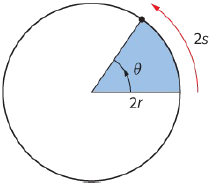
|
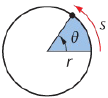
|
When we define $\theta $ in this way, its units are radians rather than degrees. How are radians related to degrees? If an object moves all the way round the circumference of the circle, it moves a distance of $2\pi r$.
We can calculate its angular displacement in radians:
$\begin{array}{l}
\theta = \frac{{circumference}}{{radius}}\\
= \frac{{2\pi r}}{{2r}}\\
= 2\pi
\end{array}$
Hence a complete circle contains $2\pi $ radians. But we can also say that the object has moved through ${360^ \circ }$.
Hence:
${360^ \circ } = 2\pi \,rad$
Similarly, we have:
$\begin{array}{l}
{180^ \circ } = \pi \,rad\,\,\,\,\,\,\,\,\,\,\,\,\,\,\,\,\,\,\,\,\,\,\,\,\,\,\,\,\,\,\,\,\,\,\,\,\,\,\,\,\,\,\,\,\,{90^ \circ } = \frac{\pi }{2}\,rad\\
{45^ \circ } = \frac{\pi }{2}\,rad
\end{array}$
and so on
Defining the radian
One radian is defined as the angle subtended at the centre of a circle by an arc of length equal to the radius of the circle.
This is illustrated in Figure 16.4.
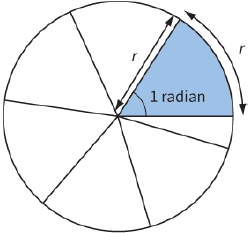
An angle of ${360^ \circ }$ is equivalent to an angle of $2\pi $ radians. We can therefore determine what 1 radian is equivalent to in degrees.
$1\,radian = \frac{{{{360}^ \circ }}}{{2\pi }}$
or $1\,radian \approx {57.3^ \circ }$
If you can remember that there are $2\pi $ rad in a full circle, you will be able to convert between radians and degrees:
- to convert from degrees to radians, multiply by $\frac{{2\pi }}{{{{360}^ \circ }}}$ or $\frac{{\pi }}{{{{180}^ \circ }}}$.
- to convert from degrees to degrees, multiply by $\frac{{{{360}^ \circ }}}{{2\pi }}$ or $\frac{{{{180}^ \circ }}}{{\pi }}$.
Now look at Worked example 1.
Question
2) a: Convert the following angles from degrees into radians: ${30^ \circ }\,,\,{90^ \circ }\,,\,{105^ \circ }$.
b: Convert these angles from radians to degrees: $0.5\,rad\,,\,0.75\,rad\,,\,\pi \,rad\,,\,\frac{\pi }{r}\,rad$ .
c: Express the following angles as multiples of π radians: ${30^ \circ }\,,\,{120^ \circ }\,,\,{270^ \circ }\,,\,{720^ \circ }\,$.